On February 25, 2026, the SC Court of Appeals ruled in favor of the Town of Sullivan’s Island’s efforts to protect the maritime forest. As the Post and Courier reported: “The South Carolina’s Appeals Court rejected efforts from a pair of homeowners to enforce a “selective thinning” plan that would have required an unprecedented number of trees in the lush forest to come down. CLICK HERE to read the full article. You can also see the COMPLETE SC CIRCUIT COURT OF APPEALS RULING HERE.

Post and Courier columnist Brian Hicks called the ruling “monumental” for conservation efforts in South Carolina, but he warns that the future of the forest will continue to be endangered if the small group of homeowners who want to cut forest down for better ocean views continue their legal battle, and if residents don’t continue to support candidates and policies that support the preservation of the maritime forest.

As we have written about before, the Maritime forest is a boon to island safety and taxpayers. Take two examples. Currently, the city of Charleston is looking to invest $1.3 billion in a sea wall (much like you would find in the Netherlands), to protect the Holy City from rising sea waters, storm surge and hurricanes. This kind of protection is exactly what Sullivan’s Islanders have with the maritime forest, yet there is still a push to destroy the forest, as we continue to see with the ongoing lawsuit brought by a handful of front beach homeowners who want to cut back the forest for better ocean views at the expense of the protection afforded thousands of othe neighbors.

Secondly, look at what our neighbors on the Isle of Palms are grappling with. In February, the Post and Courier reported that tax increases for residents are being considered to pay for the $32 million beach renourishment project that is so desperately needed to protect homes and property from erosion. Our maritime forest is a buffer for this kind of erosion. If it is destroyed, it could generations to grow back, and millions of dollars in renourishment projects to protect homes currently protected by the forest.

Please stay informed about the debate over the maritime forest, because it does have a direct impact on every islanders safety and property values, not to mention a natural wonder that is not often seen along the entire East Coast.

Sullivan’s Island for All made the decision to respond to a recent opinion piece in the Post and Courier that mischaracterized the maritime forest, the Town of Sullivan’s Island forest management plan and our organization. Thank you for taking the time to get the facts on these important issues. Here is our response, which ran on the commentary page of the Post and Courier on January 21, 2026.

After reading the Jan. 7 commentary regarding the status of the maritime forest management plan on Sullivan’s Island, a reader might conclude there is no plan. Let’s look at the facts together.

Left out was crucial information, including the core tenets of the current management plan, which is consistently enforced and updated on the town website (most recently in August as part of the “Resilience and Sea Level Rise Adaptation Plan”). Through public hearings, council meetings and town-sponsored forest walks, residents have numerous opportunities to provide input.

Town Council has taken proactive steps to manage this fragile ecosystem. In 2024, the town hired a director of resilience and natural resource management, a naturalist with a master’s degree in environmental studies and public administration, strengthening stewardship and ensuring science-based management.

Working with the naturalist, adjacent homeowners obtained permits to remove more than 1,300 invasive popcorn trees, replacing them with native wildflower seeds to prevent re-establishment. These efforts demonstrate successful collaboration between the town and residents to maintain forest health and resilience.

The management plan also includes:

• Seasonal permits allowing adjacent homeowners to trim wax myrtles and eastern baccharis to five feet between their property and the ocean from Nov. 1 through Feb. 28.

• Boardwalks providing access to the forest and beach while protecting dune integrity.

• Interpretive signs and low-impact trails, including an ADA-accessible section.

• Naturalist-led walks to educate the public and highlight the forest as a community asset.

• Camera surveillance that protects people and public land and monitors forest conditions.

• Certification of contractors approved to work in sensitive ecosystems.

The op-ed writer described the maritime forest as a “stagnant swamp,” mischaracterizing its true value, and suggesting it be drained. Like all healthy maritime forests, this one contains diverse wetlands, from bird-filled cattail marshes to areas reminiscent of blackwater swamps.

The forest’s miracle is its extraordinary ability to hold and manage water: Each tree absorbs 10 to 150 gallons daily, collectively handling millions of gallons of runoff that would otherwise flood streets and yards. Draining these wetlands would be temporary at best, and it would destroy vital water storage.

The writer suggests the maritime forest uniquely drives mosquitoes and requires special treatment. Anyone living in the Lowcountry knows mosquitoes are everywhere. Charleston County Mosquito Control confirms the forest requires no extra measures.

The county’s primary approach is larval control using extremely low-dose products that pose no material risk to people, pets or pollinators. Aerial spraying using the Trumpet chemical referenced by the writer is employed only in rare, extenuating circumstances with advance public notice. According to the county, no aerial use of Trumpet has occurred on Sullivan’s Island since 2017.

Balancing conservation with homeowners’ desire for ocean views is challenging, but beware radical forest management as some propose.

For more than 15 years, two plaintiffs have sued the town to try to manage the forest through extensive cutting, disregarding its value to the broader community. These efforts culminated in a controversial mediation settlement in 2020 that would have removed up to 96 percent of vegetation in some areas and increased flooding risks, according to the South Carolina Department of Environmental Services (formerly DHEC).

Thankfully, a subsequent Town Council challenged the settlement, and in 2023 a circuit judge ruled it “invalid and unenforceable.” The homeowners have again appealed, with a ruling expected soon. Despite the writer’s claim that council has “kept the town mired in litigation,” it is the plaintiffs who continue to do so.

The writer also criticized an “off-island … corporation” for conservation efforts. The group is actually a grassroots 501(c)(4) nonprofit, Sullivan’s Island for All (SIforAll), formed in 2021 after the mediation settlement threatened destruction of the forest.

Its leadership consists of island neighbors — a surgeon, business owners, former council members and a volunteer missionary. Funds raised have supported Earth Day celebrations for families, guided forest walks, educational outreach and legal research. Education programs have included collaborations with the Sullivan’s Island Bird Banding Station, Charleston County Public Library, the Island Turtle Team and the South Carolina Aquarium.

Finally, consider this perspective: The city of Charleston is pursuing a $1.3 billion seawall to protect life and property from rising seas and storm surge. Sullivan’s Island already has a natural, sustainable seawall — the maritime forest. Supporting the town’s management efforts preserves this invaluable resource. We must do everything we can to protect what protects us.

Dr. Howard Holl is president of the Sullivan’s Island for All board. Board members Dr. Norman Khoury, Susan Middaugh, Rita Langley, Dan Krosse and Karen Byko also signed this commentary.

If you find all the talk about the Maritime Forest legal proceedings complicated, you’re not alone! The Island Eye newspaper recently ran a comprehensive article that will bring you up to speed on the legal back and forth between those who want to radically cut the forest and those who want to save this natural sea wall that protects all of us from sea rise and storm surge. Here is the article in full:

October 28, 2025

Nicole Seitz

Over the past 15 years, a legal battle involving the Town of Sullivan’s Island’s maritime forest and some homeowners who front it has been tossed back and forth more than the sea spray along the accreted land in question. This month, the issue is again before the South Carolina Court of Appeals as the appellants respond to a 2023 decision ruling that a 2020 settlement with the town was unenforceable.

The nearly 200-acre maritime forest on the southern tip of Sullivan’s Island has been described as resilient, flourishing, and protective — but the same could be said of the dispute between a few front beach property owners and the Town of Sullivan’s Island, the proprietor of the land in trust. Now back in court are the parties in a case that began in 2010, when oceanfront homeowners who could no longer see the ocean sought to force the town to trim and maintain original views of a shoreline that had moved farther away. Both parties are resilient — each has sued and countersued.

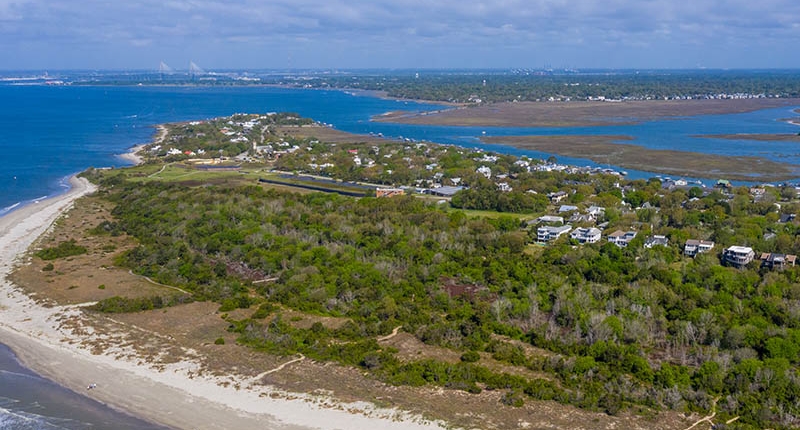
Things change — especially on a sea island. Sullivan’s Island is a barrier island, formed when water moves sand over time. Usually, barrier islands and oceanfront homeowners fight erosion and the very real threat of losing property. On the north end of Sullivan’s Island, this is the case. However, due to jetties built in the late 1800s, Sullivan’s Island is one of the few barrier islands in the United States with such extensive accretion of sand, land, and vegetation that a forest was created, sustained, and continues to grow.

Walk through the maritime forest today along sandy footpaths and wooden boardwalks and you’ll find secluded benches surrounded by thick underbrush and windswept trees. Many species of birds, butterflies, and bumblebees are visible, as are scurrying squirrels. Nocturnal creatures such as rodents, rabbits, raccoons, opossums, and coyotes remain hidden by day. Signs warn of coyotes in the area and of strong ocean currents, holes, and drop-offs — a caution to anyone who might swim nearby. Turn one way and see the beach as the path opens up; turn the other and catch glimpses of homes in the distance, obscured by trees and brush.

Expand 20251022_151319.jpg  

Ultimately, this maritime forest acts as a protector of the Sullivan’s Island coast. It absorbs wave and wind energy before it reaches inland, meaning the homes behind it are better protected from storms — as is Mount Pleasant.

This role of Sullivan’s Island as a Lowcountry protector is nothing new. Walk in the footsteps of history at the western end of the Sullivan’s Island Nature Trail in the maritime forest. Before the First Siege of Charleston in 1776, Col. William Moultrie led the construction of Fort Sullivan, the island’s first military fortification. It consisted of a 16-foot-thick palmetto cribbing filled with sand. During the Battle of Sullivan’s Island, the native sabal palmetto trees enabled Americans to fend off British warships, marking the first major victory of the American Revolution.

Sand and trees as protectors — that’s precisely the benefit provided by the maritime forest. Yet nature has a tendency to grow and change. That growth is at the root of the ongoing litigation. The appellants claim their property values have diminished because of the forest, yet a simple online search for homes along Atlantic Avenue fronting the maritime forest shows that the accretion is often listed as a positive feature, increasing privacy and protection while maintaining ocean views and access.

At the heart of this pending litigation is the notion that the Town of Sullivan’s Island is obligated to maintain the maritime forest vegetation — and that by not doing so, the town is in breach of contract. The most recent voided settlement spells out those obligations in detail. The original deed gives the town this power but does not obligate it.

Attorney for the plaintiffs, James Hood, said his clients “simply want the Town of Sullivan’s Island to do what it promised to do. Nothing more and nothing less.”

Expand 20251022_151334.jpg  

History of the litigation

After Hurricane Hugo ravaged the Charleston area and residents began to rebuild, the Town of Sullivan’s Island sought to protect the accreted land through a heavily restricted deed with the Lowcountry Open Land Trust. After watching a developer bulldoze accretion on Isle of Palms to make way for development, the town had the foresight to protect its own accreted land for residents’ safety as well as for its aesthetic, educational, and ecological value.

In 2010, homeowners Nathan and Ettaleah Bluestein, M.D., along with Theodore Albenesius III and Karen Albenesius, applied for a permit to cut down vegetation between their homes and the ocean. When they were denied, they sued the town (Bluestein v. Town of Sullivan’s Island). They argued that their property values were affected, that the forest was a nuisance harboring wild animals, and that their ocean views and breezes were obstructed. They pointed to the 1991 deed, claiming it required the town to keep the vegetation at the low-brush state that existed when the deed was enacted.

For a decade, the case went through several courts, including the South Carolina Supreme Court and the South Carolina Court of Appeals. In 2018, the Court of Appeals sided with the town. In 2020, the Supreme Court reversed the lower court’s ruling and recommended further proceedings due to the “ambiguity” of the 1991 deed’s language regarding maintenance obligations. A settlement was reached that same year, with the town agreeing to selective trimming — provided the homeowners obtained necessary permits and funded the work.

A new Town Council was elected in 2021. In 2023, it challenged the 2020 settlement, and a circuit court judge ruled it unenforceable, stating that a previous Town Council cannot dictate what a future Council must do with its governmental powers under the deed.

Expand 20251022_145959.jpg  

This month, the 2023 reversal was appealed by Nathan Bluestein and Theodore Albenesius III. Ettaleah Bluestein, M.D., passed away in 2019, and Karen Albenesius has since divorced and is no longer a plaintiff.

At the Oct. 8, 2025, hearing before the South Carolina Court of Appeals, the appellants’ attorney, James Hood, described his response to the nullification of the 2020 settlement:

“I think it’s illogical, and I think a conclusion that determines that maintenance of your property as you’re obligated to do it by the restrictive covenants that you negotiated, put on it, and then purchased it back — if you can’t do that as part of your proprietary function, then you can’t put on restrictive covenants. You can’t put historic easements. You can’t encumber property in the future.”

In response, attorney for the town, Greenville-based lawyer William Wilkins, argued that the 2020 settlement was too restrictive on future Town Councils.

“This prior Council is attempting to dictate to future Councils how it must spend taxpayer dollars of some unspecified amount. Without question, this is impairment of governmental powers.”

Looking forward

In April 2024, the Town of Sullivan’s Island hired a director of resilience and natural resource management, Rebecca Fanning, to use evidence-based decision-making to advise on land management and lead community engagement events fostering appreciation for the island’s natural resources.

Fanning said her role’s creation “has been a tremendous step in the right direction toward evidence-based land stewardship practices tailored to the unique challenges and opportunities of the barrier island environment.”

Sullivan’s Island is Fanning’s hometown, and she spent her childhood playing in the island’s maritime forest and forested batteries.

“I am uniquely aware of the forest succession that has taken place since the year Hugo hit,” Fanning said, “and the added value of those woods with their wonderful understories for providing forage and shelter for migratory warblers, nesting painted buntings, southern leopard frogs, fireflies, mosquito fish, praying mantises, and a host of other amazing creatures that call this place home.”

“Last year under my leadership,” she said, “several front beach homeowners pursued permits to remove more than 1,000 invasive popcorn trees from the maritime forest. Once the invasive removals were complete, I seeded the areas with beautiful saltmarsh mallow to suppress next year’s invasive reemergence, and a riot of pink blossoms emerged to greet the bumblebees that depend on native plant nectar and pollen to feed their young. We are only just getting that popcorn removal permitting process the attention it deserves, and I expect we will at least double that number this winter season.”

Town Administrator Joe Henderson said, “The town is committed to protecting its governmental powers by acting in the public interest on matters concerning the preservation and maintenance of the maritime forest now and in the future.”

Expand 20251022_145011.jpg  

At the Oct. 8, 2025, hearing, Wilkins also spoke about the validity of the 2020 agreement:

“This contract provides in perpetuity. It is to last forever, and that certainly is not a proprietary function that is appropriate. I might add that this contract says it is binding on the parties, their heirs, their successors and assigns, clearly making this a contract to last in perpetuity. The agreement also says it may not be modified or amended ‘except upon the mutual agreement of all parties and their authorized agents.’ This is clearly an attempt to give private citizens — the parties, their heirs, their successors and assigns and their authorized agents — the ability to veto any future act that any future Council wishes to take with regard to the accreted land.”

A land trust sign on the nature trail in the maritime forest claims this property at the heart of the lawsuit is “protected forever.” To many residents, it’s a promise of good stewardship for the future, but for a few, it’s a challenge — and a reminder that the fight continues.

The South Carolina Court of Appeals is expected to issue its decision by early 2026.

Island Eye News

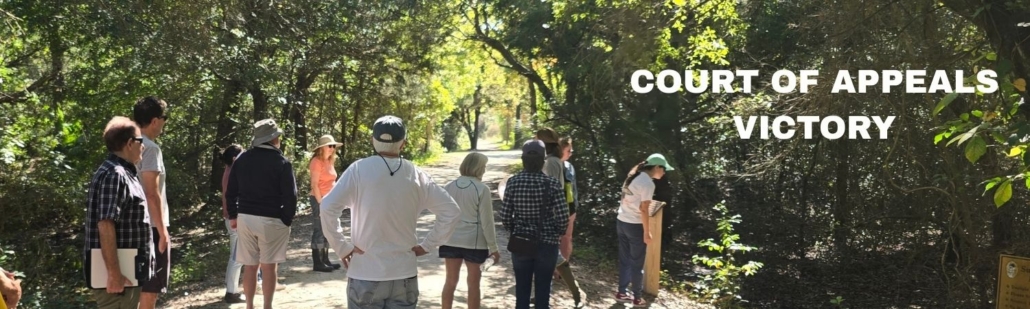
October 18th was a beautiful fall day for a walk in the maritime forest! More than a dozen people joined the event to mark SI for All’s 5th year of advocacy for the forest. The walk went through the forest and then out onto the beach to see the front edge of the maritime forest. News media attended including Count on 2 News and The Moultrie News.

Maritime Forest Under Attack Again in Court

The whole reason SI for All was founded was in response to efforts from a very small group of front beach homeowners who want to radically cut the forest for better views. That group has spent years suing the Town to allow more cutting.

In 2023, a Circuit Court Judge blocked the enforcement of a controversial settlement agreement on Sullivan’s Island that would have allowed the destruction of the Island’s unique Maritime Forest. But just last week, this small group of islanders went before the SC Court of Appeals to try to get that ruling overturned.  (News 2 coverage, Post and Courier coverage).

These attempts to destroy the forest for views will likely continue, which is why we must all work together to protect this national treasure. The forest protects all of us from storm surge and hurricanes, it provides a natural habitat to a variety of wildlife and ia a beautiful entrance to our beach. Please stand with us and protect this ecological gift.

A ruling from the South Carolina Court of Appeals is expected in early 2026. CLICK HERE to watch the court hearing held on October 8th, 2025.

This Fall marks the 5th anniversary of Sullivan’s Island for All, the grassroots advocacy group that has become a powerful voice for conservation, community, and responsible stewardship of one of the Lowcountry’s most unique natural environments: the Sullivan’s Island Maritime Forest.

Go Explore Nature in August!

Don’t miss your chance to join Town Naturalist Rebecca Fanning for a leisurely stroll along a Sullivan’s Island scenic walk near you!  CLICK HERE to sign up for a walk highlighting some of the diverse communities of plants and animals to be found along our neighborhood beach paths and saltmarsh edge. A Harborview walk is scheduled for August 9th from 2pm – 4pm starting at Station 12. Then, a Sunset on the Marsh walk is set for August 16 from 7pm. – 8pm, starting at Station 19 at the”Old Dump” lot. Rebecca has a wealth of knowledge about nature and the island that will leave you and your family wanting more!

Cool Way to Birdwatch in the Maritime Forest!

Recently, a fan of the Maritime Forest had a great suggestion for those of us who can’t tell one bird from another. It’s called the Merlin Bird ID app and you can download it to your phone easily on the Apple or Google Play store. Simply open the app and then the app will interpret the chirping nearby and pop up a photo of the bird you are near! The Merlin Bird ID app, developed by the Cornell Lab of Ornithology, is a free mobile app that helps users identify birds using various methods. It offers features like photo id and sound id, as well as step-by-step identification based on bird characteristics. The app is powered by eBird’s extensive data and utilizes machine learning to enhance identification accuracy. 

Maritime Forest Serves as Habitat and Protector

This letter to the editor written in 2021, has stood the test of time and we wanted to re-share this with you!

(Letter to the Editor Written by Grace Reed)

Sullivan’s Island does not exist in a vacuum. The importance of Sullivan’s Island’s Maritime Forest is closely related to the neighboring communities of Mount Pleasant and Charleston.

The islands along the coast of South Carolina are called “barrier islands” for a reason. They act as a barrier between the enormous forces of the Atlantic Ocean and the mainland. Were it not for the barrier islands, there would be waves crashing onto the Battery in Charleston and the Intracoastal side of Mount Pleasant. One has only to look at an aerial photo of Sullivan’s Island to realize its vital position as a massive surf break for Mount Pleasant during hurricanes.

A high density of trees and vegetation on the island serves to fortify its diffusive effect on the velocity of ocean waves during a storm surge. Thus the trees and shrubs of the Maritime Forest on Sullivan’s Island’s accreted land play an important role in the protection of Mount Pleasant and downtown Charleston, in addition to the protecting the middle and back side of the island itself.

Besides protecting the mainland, the trees and shrubs of the Maritime Forest act as a critical habitat for migratory and indigenous songbirds and butterflies. Moreover, the flora and fauna of the Maritime Forest are woven in a complex web of co-dependence to create a thriving ecosystem.

As an example, the lowly wax myrtle provides a necessary food source for tree swallows which migrate in masses of thousands and swoop through the myrtles to snatch berries on the fly. The berries of the myrtle also are a necessary food source for the beautiful myrtle warbler, which overwinters here. These birds, in turn, help to propagate the myrtles by spreading seeds in their droppings. Cutting myrtles to 3-feet or 5-feet, as designated in the Sullivan’s Island mediation agreement, could deprive the tiny warbler of protective cover, and also affect the availability and accessibility of berries. The lack of an abundant source of food could threaten individuals of both these species during their most vulnerable seasons.

Most people are aware of the habitat needs of the Monarch butterfly, which stops on Sullivan’s Island during its southern migration in fall. But they might not realize the importance of the Hackberry tree for our indigenous Hackberry butterfly. Hackberry nectar and sap are important food sources for the butterfly. Also, it lays its eggs exclusively on that species and the larva hatch to feast on the leaves of the Hackberry before pupating. The larva and butterflies, in turn, provide food for many migrating songbirds. Yet in the Sullivan’s Island mediation agreement, the Hackberry tree is considered expendable and allowed to be removed.

During the last 25 years, there has been a vitally important occurrence in Mount Pleasant that has largely gone unrecognized. For countless eons, one of the the southward neotropical song-bird migrations has generally followed the Eastern coastline. One of the reliable and important stopovers on their journey has been Patriots Point, where the birds have dropped down for rest, food and water before crossing the “big water” of Charleston Harbor. However, the state-sanctioned development of Patriots Point has resulted in a significant loss of valuable habitat. When the millions of migrating birds and butterflies arrive here, each year there is less land and vegetation to support them.

However, as that door has shut, a window has opened in the growth of an alternative habitat on Sullivan’s Island, just a few miles away.

The importance of Sullivan’s Island’s Maritime Forest is interwoven with the area around it, both as habitat and in storm surge mitigation. Its protection should be considered vital for Islanders and mainlanders alike.